Wine and Spirits Alchemy Wine and Spirits Maturation
Rural Alchemy - 1 Overview
Old-World Wisdom, Modern Innovation, and a Little Rural Alchemy
Great wines and spirits are never the result of luck—they are the product of careful craftsmanship, patient observation, and an endless desire to improve. In the Rural Alchemy series, we'll take you behind the scenes at Seven Springs Farm to discover how old-world traditions and modern innovation come together to transform the harvest into something truly extraordinary.
Introduction
There was a time when nearly every farming family knew a little something about making wine, cider, beer, vinegar, cheese, or preserving the harvest for another season. Most of that knowledge wasn't learned from books. It was passed from one generation to the next around the dinner table, in the barn, or while standing beside a kettle, a barrel, or a still. You learned by watching, asking questions, making mistakes, and trying again.
Much of that practical wisdom has faded over the years, replaced by factory production and the idea that good food and drink simply come from a store shelf. Yet the old ways still have much to teach us. They remind us that patience matters, that nature doesn't always follow a schedule, and that paying attention is often more important than buying another expensive gadget.
This Rural Alchemy series is our way of sharing some of those conversations. We'll explain why we do things the way we do, separate tradition from myth, and occasionally challenge ideas that have been accepted simply because "that's how it's always been done." You won't need a degree in chemistry or biology to follow along. Just bring your curiosity—and perhaps a glass of something you enjoy—and let's explore the fascinating world where old-world craftsmanship, modern innovation, and a little Rural Alchemy come together.
Saving America's Old-Growth Forests, One Barrel at a Time
For centuries, oak barrels have been an indispensable part of crafting fine wines and spirits. They contribute flavor, aroma, color, and character in ways that have become part of the world's great winemaking and distilling traditions. We deeply respect that heritage.
What many people don't realize, however, is what each new barrel represents. A standard American oak barrel requires roughly 150 pounds of carefully seasoned white oak, much of it dense heartwood from mature trees. That single barrel will typically mature about 265 bottles of wine or approximately 465 bottles of 80-proof spirits before its primary role is complete.
At Seven Springs Farm, we began asking a simple question: Could we achieve the same beautiful oak influence while asking far less of the forest?
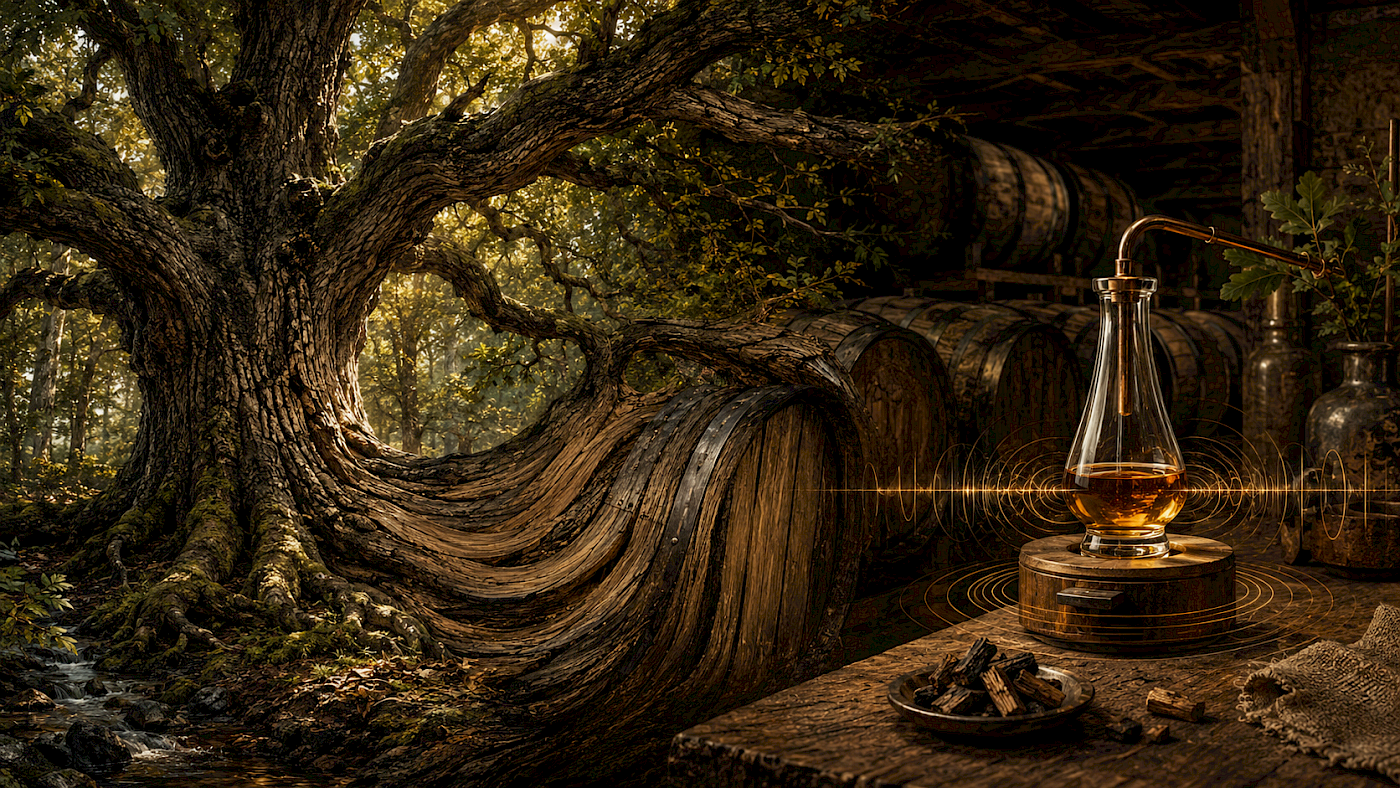
That question led us to what we call Rural Alchemy. Instead of relying on an entire barrel, we carefully extract the same desirable oak compounds from less than eight pounds of oak. Even better, that wood doesn't have to come from the heart of a centuries-old tree. Properly selected limbs, branches, and other forestry by-products—materials that might otherwise become mulch, firewood, or simply return to the forest floor—can provide the character we're looking for while dramatically reducing the amount of new hardwood required.
Will oak barrels ever disappear? We certainly hope not. They are beautiful, historic, and an important part of our craft. But if modern knowledge allows us to produce exceptional wines and spirits while using only a small fraction of the wood that tradition has demanded for centuries, we believe that's an idea worth exploring. That's Rural Alchemy.
We're Not Reinventing Nature—We're Learning from Her
If you've followed us this far, you may be wondering what this "Rural Alchemy" actually looks like. The answer is surprisingly simple. We aren't trying to outsmart nature—we're learning from her. Over the coming few articles we'll explore each step in detail, but here's a glimpse behind the curtain.
We begin with carefully selected toasted oak. Think of it as the inside surface of a traditional barrel, distilled down to only the portion that actually contributes flavor and aroma. Instead of asking for wine or spirits to wait years for that interaction, we simply present much more oak surface in a much smaller package.
Of course, wood can only influence wines or spirits if the liquid actually touches it. Nature solves that problem slowly. We encourage it gently by creating hundreds of millions of microscopic bubbles with carefully controlled ultrasound. Those tiny bubbles continuously carry the liquid into intimate contact with the toasted oak—never violently, always in carefully measured doses.
Between these bubble sessions, our wines and spirits are never allowed to sit idle. For centuries, casks crossing the Atlantic quietly rolled and pitched with every wave, helping their contents mature along the journey. We recreate that same gentle, rhythmic motion here on the farm, giving every batch its own little "ocean voyage" without ever leaving Indiana.
Oak also contains naturally occurring trace minerals and other compounds that add nothing to a fine wine or spirit. Fortunately, nature has already shown us elegant ways to deal with them. By combining ultraviolet light (sunlight on a sea-level beach) with one of nature's oldest water-cleansing partners—ordinary organic barley straw—we encourage those unwanted trace compounds to leave while preserving everything we worked so hard to create.
Each of these ideas deserves its own conversation, and each will become a future Rural Alchemy article. Individually, none of these techniques seems especially remarkable. Together, they allow us to create the character of a spirit that tastes as though it has spent a decade patiently maturing in oak—yet from the moment it leaves the still until it is ready for the bottle takes only about twenty-four hours. That's not magic. It's simply the patient observation of nature, thoughtfully repackaged for the twenty-first century.
Why Doesn't Everyone Do This?
If these ideas make so much sense, a fair question naturally follows: Why isn't every winery and distillery doing the same thing?
The answer has less to do with science than with economics.
The world's largest wineries and distilleries collectively own billions of dollars' worth of wines and spirits quietly maturing in hundreds of thousands of oak barrels. Those barrels are not simply production equipment—they are inventory, and that inventory is a major part of the value of the business itself. Investors expect products to spend years, and sometimes decades, aging before they are sold, because time in the warehouse has long been part of the financial model that creates premium brands.
Modern maturation technologies have become increasingly sophisticated, but adopting them on a large scale would require rethinking decades of infrastructure, warehousing, inventory management, financing, and brand positioning. For many established producers, the challenge isn't whether they could change. It's whether changing would make economic sense.
Small farm producers live in a different world.
At Seven Springs Farm, we don't need millions of dollars tied up in warehouses full of aging barrels before we can offer something exceptional. We don't need to multiply our production costs tenfold to build a successful business. Instead, we can focus on producing outstanding wines and spirits using far less wood, far less storage, far less energy, and far less time—while still honoring the craftsmanship that generations before us perfected.
That is the promise of Rural Alchemy. It isn't about replacing tradition. It's about giving small, thoughtful producers the opportunity to stand beside much larger competitors by combining old-world wisdom with modern innovation. If that also happens to leave healthier forests for the generations that follow us, so much the better.