Wine and Spirits Alchemy Accelerated Maturation
Rural Alchemy-2, Tiny Bubbles
Don Ho sang “tiny bubbles in the wine…” in 1966
“We put tens of millions of tiny bubbles not just in the wine, but in our distilled spirits also.
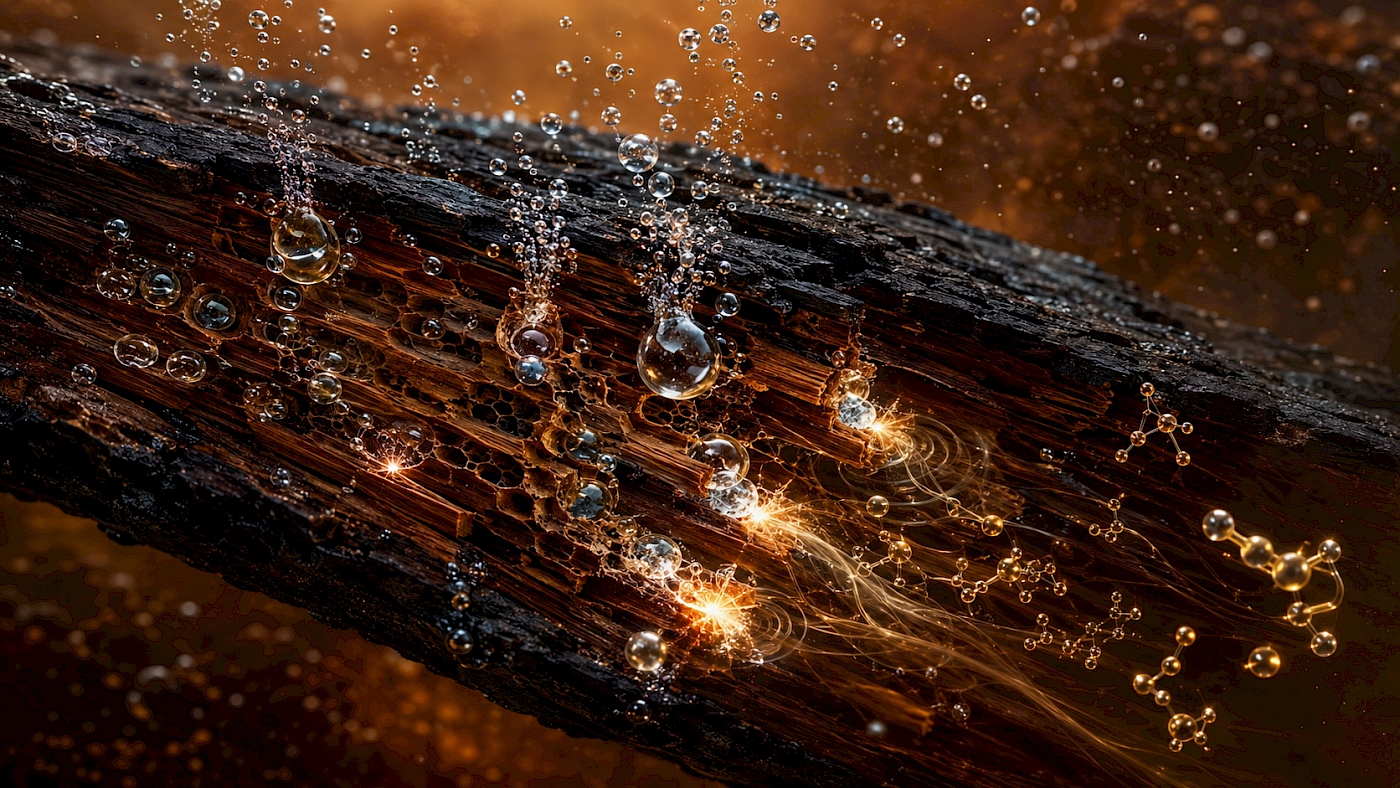
These bubbles are not filled with carbon dioxide, and they do not rise gently to the surface. Created by carefully controlled ultrasonic energy, they form, expand and collapse in fractions of a second. That microscopic violence—known as cavitation—encourages interactions among the spirit, oxygen and oak that ordinarily unfold only during months or years of barrel aging.
And those tiny bubbles do far more than just ‘make me feel fine.’
Introduction
At Seven Springs Farm, we use this very modern science to accelerate some very old and entirely natural processes. The goal is not to imitate age or manufacture the illusion of maturity. It is to give nature a more efficient place to work—softening harsh edges, integrating flavors and extracting the character of oak without waiting for a barrel and the calendar to do all the work.
In this second installment of Rural Alchemy, we will look inside those tiny bubbles, discover what happens when they collapse and explain how something almost too small to see can profoundly influence what you eventually taste in the glass.”
What’s a “Cavitation Bubble,” and Why Is It Important?
A cavitation bubble is an extraordinarily small pocket created when ultrasonic energy moves through a liquid. At the carefully selected frequency we use—one of the secrets of our process—these bubbles are only about 1 to 1.5 micrometers (µm) in diameter (a human hair is between 17 to 181 µm depending on ethnicity). They travel through the wine or spirit at roughly 2.5 meters per second, reaching places that ordinary mixing cannot—including the microscopic spaces between the fibers of our oak chips.
As a bubble forms and expands within those spaces, it pushes the surrounding wood fibers apart. Then, in a fraction of a second, it violently collapses. That collapse creates an intense but extremely localized burst of energy, producing temperatures around 149°C (300°F) at the microscopic point where it occurs.
Those tiny bursts of heat and pressure help the alcohol reach into the oak and dissolve the desirable compounds held within it—the “good stuff” responsible for color, aroma, flavor and a smoother character. Millions of nearly invisible bubbles can therefore accomplish in a remarkably short time some of the work that ordinarily requires prolonged contact between wine or spirits and wood.
Why Use Wood Chips and How Big Are They
A standard 53-gallon whiskey barrel presents approximately 21 square feet of interior wood surface to the spirit. Yet only the inward-facing side of each stave can touch the liquid; the rest of the barrel’s roughly 150 pounds of oak provides strength and structure but contributes little directly to maturation. Wood chips eliminate most of that unused bulk.
Our chips are approximately the size of an adult’s index fingernail and about twice as thick as the nail itself—roughly ½ inch square and 0.04 inch thick. Because the chips move freely through the wine or spirit, both broad faces are exposed. At that size, approximately 6,000 chips provide about as much exposed oak surface as the entire interior of a standard barrel.
Those 6,000 chips weigh only about 1⅔ pounds. We triple that theoretical amount to provide abundant oak contact—approximately 5 pounds of chips—yet that is still only about 3% of the weight of a 150-pound barrel. We are not using less active oak surface; we are simply putting far more of the wood we use to work.
Um Um Good, Roasted Oak Chips
Freshly cut oak may smell wonderful, but “raw wood” is not the flavor we want in a wine or spirit. Untreated oak can contribute harsh tannins, bitterness and green, woody flavors. Roasting—usually called toasting in winemaking and distilling—softens those less desirable qualities while transforming some of the wood’s natural compounds into much more interesting flavors and aromas.
As the oak reaches a medium toast, heat unlocks notes of vanilla, caramel, warm spice and toasted wood. It also makes the oak’s desirable compounds easier for the alcohol to extract. A darker char can add smokier flavors and create a thin carbonized layer, but medium-toasted oak gives us a broader, more balanced palette without allowing smoke or bitterness to dominate.
We therefore roast perfectly lovely oak for the same reason we roast coffee, toast bread or brown food in a skillet: heat creates flavors that were not present—or not readily available—in the raw ingredient. The oak remains oak, but it becomes a far more generous and flavorful partner in the maturation process.
By the way, we do not use toasted oak in our white wines or crystal-clear spirits. For our white wines—Siren and Juno—we use very lightly toasted cuttings from the grapevines. In our crystal-clear eau-de-vie brandies, we use a very small amount of lightly toasted fruitwood: apple for Eve and cherry for Cherry Bomb.
Bubble, Meet Wood. Wood, Meet Bubble.
Roasting and charring begin the transformation of oak; cavitation helps us reach and extract the results. As millions of microscopic bubbles expand between the wood fibers and then collapse, they create tiny pulses of heat, pressure and liquid movement. These effects expose more of the wood’s internal structure and help the alcohol collect the flavorful compounds waiting there—the “good stuff.”
Heat transforms part of the oak’s (or grape/apple/cherry) lignin into aromatic compounds, including vanillin, which contributes vanilla notes, and guaiacol, which adds hints of smoke and spice. At the same time, hemicellulose breaks down into simpler sugars and develops a reddish toasted layer containing compounds such as furfural and 5-hydroxymethylfurfural. The names may sound intimidating, but their contributions are familiar: caramel, toffee, butterscotch and almond.
Toasting also makes the oak’s natural lactones more readily available. These compounds contribute to the woody and sometimes coconut-like notes commonly associated with oak-matured wines and spirits. Cavitation helps move the liquid into the wood and bring these desirable flavors back out, where they can become integrated into the wine or spirit.
Charring adds another benefit by creating a thin, porous carbon layer on the wood’s surface. Like a tiny natural filter, this layer adsorbs some undesirable compounds—including certain sulfides, fusel oils and other harsh-tasting congeners. The wood therefore does two jobs at once: it contributes desirable flavors while helping remove or reduce some of the rough edges we would rather leave behind.